

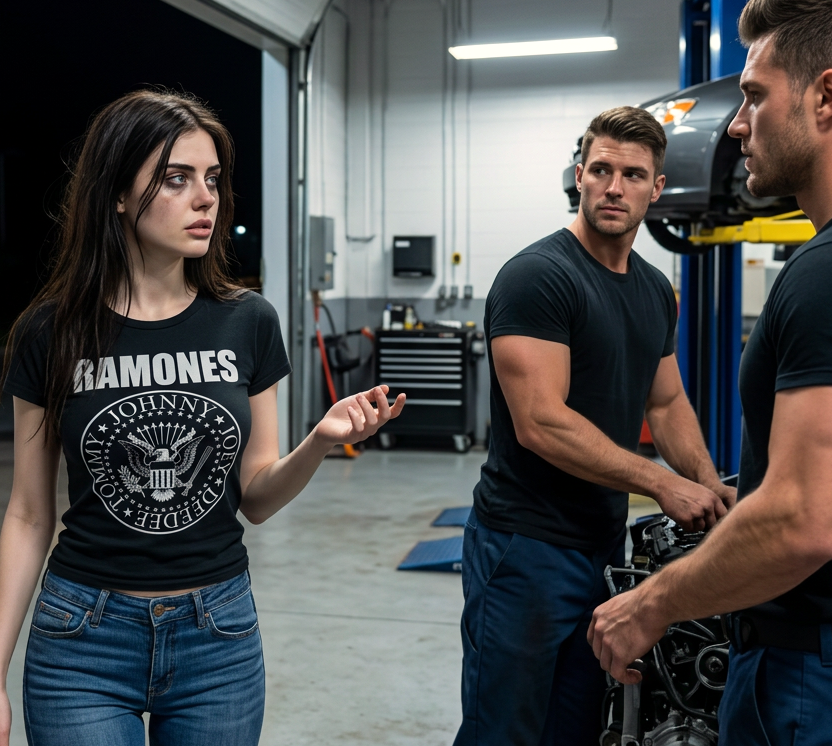
Sinclair’s late-night arrival at the garage was random and necessary. The two mechanics at the garage were ready for her. This story comes in several parts.
The night air had turned brittle, a sharp, biting wind that snaked through the valley, rattling the frame of Sinclair’s sedan. She had been driving for hours, the rhythmic hum of the tires against the asphalt acting as a hypnotic metronome, but the engine had been complaining for miles. First, a rhythmic metallic tapping that blossomed into a jagged, uneven stutter. Then, a plume of acrid, white smoke curled from beneath the hood, ghosting past her windshield like a warning.
She fought the steering wheel as the power steering died, a heavy, dead-weight resistance, coaxing the vehicle off the winding state road and onto the gravel shoulder. The car rolled to a silent, lurching halt, settling into the dirt with a final, defeated groan.
Silence rushed back in, absolute and heavy.
She turned the key again, but the engine didn’t even click. Just a hollow, mocking void. Sinclair sat back, her fingers still curled around the leather of the steering wheel. She was miles from the nearest town, the GPS on her phone flickering—a lost signal in a sea of darkness. The only thing breaking the horizon was the distant, jagged silhouette of an industrial structure hunkered against the tree line.
She stepped out of the car, the gravel crunching loudly under her boots. The air here was different—stagnant and thick. As she walked toward the looming shape, the scent hit her first: high-octane gasoline, the metallic tang of iron, and the deep, earthy musk of burnt oil. It wasn’t the sterile smell of a dealership; it was raw, honest, and heavy.
The building was a corrugated metal beast, its bay doors pushed open just enough to spill a rectangle of sickly yellow light onto the apron. It looked like the mouth of a furnace. She approached, her boots echoing against the concrete pad. Inside, the space was a cathedral of chaos—tools hung on pegboards like surgical instruments, racks of tires stacked toward the rafters, and in the center, a vehicle was hoisted mid-air, its guts exposed.
Sinclair stopped at the threshold. The wind tugged at her jacket, but she didn’t pull it tighter. There was a pull here, a gravitational distortion that felt less like a breakdown and more like an arrival.
“You’re a long way from the interstate,” a voice growled from the depths of the bay.
Sinclair stood her ground, her eyes adjusting to the flickering neon hum of the shop. Two men emerged from the shadows beneath the raised chassis. The one who spoke, Bob, wiped his hands on a rag that was more black oil than fabric. He was built like an anchor, his shoulders straining against a grease-stained Henley, his presence anchoring the cavernous space. Beside him, Chris moved with a predatory stillness. He was leaner, his forearms corded with muscle, his dark eyes fixed on her with a silent, analytical intensity that felt like a touch.
She looked at the car, then back at them. The frustration of the breakdown evaporated, replaced by a sudden, jagged spike of adrenaline. The air in the garage was humid, held captive by the heat of the cooling engine blocks and the intensity of two pairs of eyes that were no longer looking at her car, but at her.
“The engine didn’t want to go any further,” Sinclair said, her voice steady despite the thrumming in her chest.
Bob took a step forward, his boots heavy on the concrete. He didn’t look at the vehicle; he looked at the way her hair fell over her shoulder, the way her stance had shifted from defensive to expectant. Chris didn’t say a word, but he leaned back against a workbench, crossing his arms, his gaze tracing the line of her throat.
The silence between them stretched, thick and conductive. There was no pretense of professional detachment now. The brusque, late-night mechanic routine had dissolved, leaving behind only the raw, biological recognition of three people caught in the sudden orbit of an electric tension.
Sinclair felt the space around her shrink. She realized then that she wasn’t waiting for a repair. She was standing at the edge of something, and these two men were the gatekeepers. She took another step inside, the heavy, oil-saturated air clinging to her skin, and for the first time that night, she stopped caring about the car at all.
The garage felt like the belly of a leviathan, hollowed out and lined with the rusted skeletons of machinery. Sinclair stood in the threshold, the silence of the bay punctuated only by the rhythmic drip of condensation hitting a steel drum. Bob stepped forward, his boots heavy on the concrete, his silhouette framed by a dangling, flickering shop light. He didn’t reach for a wrench; instead, he wiped his palms slowly against the oil-slicked thighs of his work pants. The fabric was stiff, stained with the labor of decades, yet his movements were fluid, predatory.
Beside him, Chris shifted. He didn’t emerge into the light as Bob had. He leaned against the workbench, a blur of motion in the periphery, his eyes never leaving Sinclair’s face. The professional distance that had defined their brief interaction at the sedan was evaporating, replaced by a humid, static-charged intensity that made the fine hairs on Sinclair’s arms stand up.
“It’s not the starter,” Bob said, his voice a low, gravelly rasp that seemed to vibrate against the corrugated metal walls. He wasn’t talking about the car anymore. He was talking about the hunger.
Sinclair took a step further into the space. The scent hit her harder here—raw petroleum, burnt rubber, and the distinct, musk-heavy heat of two men who had spent the last twelve hours sweating under the hoods of engines. It was primal, a scent that bypassed the logic of the mind and landed directly in the pit of her stomach. She felt her pulse jump, a frantic, rhythmic drumbeat against her throat.
“I think I know that,” Sinclair replied. Her voice sounded thin, but steady. She watched Bob’s eyes track the movement of her breath, his gaze lingering on the hollow of her collarbone.
Chris pushed away from the workbench, the metallic scrape of his movement drawing Sinclair’s attention. He moved with a quiet, feline grace, cutting the distance until he was standing just behind Bob, forming a wall of solid, uncompromising muscle between her and the dark expanse of the garage exit.
“Late night to be out on your own,” Chris said. His voice was lighter than Bob’s, a soft, perceptive velvet that carried a hidden edge of command. He reached out, his hand hovering inches from her shoulder, not touching, but close enough that she could feel the heat radiating from his skin. “You look like you were looking for something.”
“I was looking for a mechanic,” Sinclair said, her gaze darting between them. She felt cornered, yet she was the one who had walked into the trap. The thrill of it made her head swim.
Bob stepped into her personal space, his chest mere inches from hers. He was taller, broader, a wall of heat. He didn’t touch her, but he leaned in, his nose inches from the side of her neck. She could smell the soap and the iron in his scent. “Found two,” he murmured.
He brought a hand up, slowly, deliberate in his movements. His fingers were calloused, stained with a dark, permanent map of carbon and grease. As he brushed his thumb across her cheek, the friction was rough, almost abrasive, but it sparked a flare of electricity that raced down her spine. The grit on his skin left a faint, charcoal-colored smudge on her pale face—a mark of ownership, a brand of the night.
Sinclair didn’t flinch. Instead, she leaned into the touch, a small, involuntary gasp escaping her lips. The sound echoed in the high rafters, amplified by the emptiness of the shop.
Chris didn’t just watch; he moved to her other side. He didn’t speak, but his presence was a heavy, magnetic pull. He reached out and tucked a loose strand of hair behind her ear, his fingers lingering on the sensitive skin of her neck, his touch feather-light compared to Bob’s firm, dominant grip. He was the contrast, the whisper to Bob’s roar.
“You’re shaking,” Chris observed, his eyes scanning her face with an intensity that felt like he was reading the rhythm of her heart.
“I’m not cold,” she whispered, her eyes locking with Bob’s, who was watching her reaction to Chris with a look of possessive satisfaction.
“Good,” Bob said, his hand sliding from her cheek to the nape of her neck, his grip firming. He tilted her head back, exposing her throat to the dim, yellow-orange glow of the flickering bulb. “Because it’s about to get much, much hotter in here.”
The air in the garage seemed to thicken, becoming almost liquid. The transition was seamless—the professional facade discarded like a grease-stained rag. Bob’s hand moved down, tracing the line of her shoulder, his palm grazing the fabric of her blouse, pressing just hard enough to remind her of his strength. Chris remained a constant pressure on her opposite side, his fingers tracing the curve of her arm, his thumb sweeping rhythmically across the inside of her wrist, measuring her rising heart rate.
There was no negotiation, no tentative back-and-forth. It was a silent, mutual pact of surrender. Sinclair felt her own hands rise, her fingers clutching the thick, denim fabric of Bob’s shirt, the coarse texture rough against her palms. She felt the heavy, solid wall of his chest beneath it, the heat of his body demanding hers.
She tilted her head, her breath hitching as Bob’s lips grazed the sensitive junction where her neck met her shoulder. It was a searing, possessive heat. Chris, seeing the opening, stepped closer, his body molding against her side, his arm sliding around her waist, pulling her into the space between them.
The concrete floor beneath her boots felt cold, grounding, a stark contrast to the burning, chaotic wildfire starting to bloom in her blood. She was caught, held by two men who moved with the calculated, mechanical precision of the machines they spent their lives repairing, yet with a raw, unrefined desire that felt entirely untethered.
“Are you going to fix me?” Sinclair breathed, her voice a tremor of anticipation.
Bob pulled back just enough to look her in the eye. A slow, predatory smile spread across his face, his teeth white against his dark-stained lips. “We’re going to take you apart,” he promised, his voice low and vibrating with intent, “and see exactly what makes you run.”
Chris stepped in, closing the final gap. His lips brushed her temple, his breath warm against her ear. “Piece by piece.”
The pact was sealed. The garage, once a place of repair and transit, transformed into an altar. Sinclair felt her inhibitions fraying, the last threads of her composure unraveling in the face of their quiet, intense focus. She didn’t want to leave. She didn’t want the car fixed. She wanted to lose herself in the grease, the grit, and the overwhelming, intoxicating reality of being the singular focus of these two men.
As Bob’s hand reached for the top button of her blouse, the world outside—the road, the stalled sedan, the logic of her life—ceased to exist. There was only the flicker of the overhead light, the smell of oil, and the slow, deliberate work of hands that knew exactly how to dismantle the world around them.
Check back Tuesday night for Part 2, or call me tonight to sin together.
Our number is in my name: 888-750-4SIN (4746) X832