

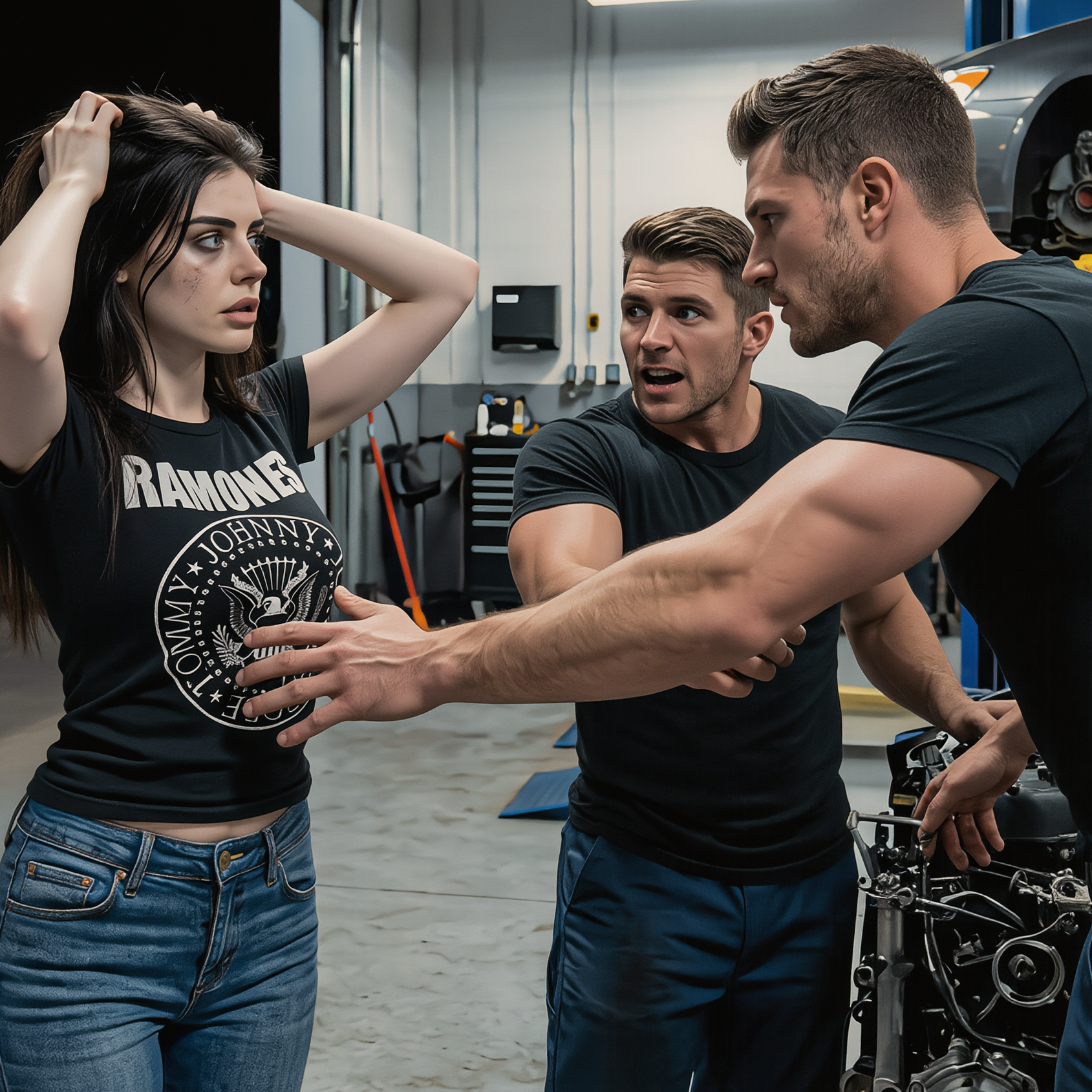
The heavy scent of oil and gasoline was amplified by the heat. Sinclair suddenly imagined herself under a cool waterfall, the two mechanics in front of her, jerking off for her.
The heavy metal door of the Midnight Bay garage groaned, a long, shivering protest of rusted hinges that echoed into the rafters. Sinclair stepped across the threshold, the transition from the cool, damp night air to the suffocating, sweltering heat of the workshop feeling like walking into the mouth of a furnace.
The space was an abyss of shadows, illuminated only by the rhythmic, sickly flicker of a dying neon sign hanging precariously above a grease-slicked workbench. Everywhere she looked, the architecture of industry stood as sentinels: towers of discarded tires, towering hydraulic lifts that loomed like skeletal giants, and the pervasive, cloying perfume of raw gasoline and burnt motor oil. It clung to the back of her throat, thick and metallic, coating her lungs with a scent that felt far too carnal for a place of business.
She stood frozen in the doorway, the frantic ticking of her cooling sedan’s engine still echoing in the distance behind her. She was acutely aware of her own silhouette against the moonlight—vulnerable, exposed, and entirely out of her depth.
Out of the darkness at the far end of the bay, two shapes detached themselves from the gloom.
Bob stepped into the meager puddle of light first. He was a mountain of a man, his work shirt sleeves rolled tight against thick, corded forearms that were mapped with a lifetime of mechanical labor. A smear of black grease streaked across his cheekbone like war paint, catching the intermittent, buzzing light of the neon. He didn’t walk so much as prowl, his heavy boots making no sound on the concrete.
Trailing half a step behind him was Chris. He was leaner, wire-thin and coiled with a kinetic, predatory grace. His eyes, dark and unblinking, seemed to drink in the shadows. He didn’t look at the mess of her engine or the tools scattered across the floor; he looked at her.
“Car’s dead, then?” Bob’s voice was a low-frequency rumble that seemed to vibrate in the floorboards beneath her feet. It wasn’t a question so much as a declaration of the new reality.
Sinclair found her throat tight, her voice emerging as something softer, breathier than she intended. “Sputtered out a mile back. I… I saw the sign.”
Bob didn’t offer a polite smile or a professional greeting. He merely stepped closer, invading her personal space until the heat radiating off his body mingled with the scent of ozone and iron. He was looking at her not as a stranded motorist, but as something he was cataloging, his gaze dropping to the rise and fall of her chest, then back to her eyes with a deliberate, searching intensity.
“Midnight Bay doesn’t get many visitors after hours,” Chris added. His voice was a stark contrast to Bob’s—a smooth, quiet baritone that cut through the silence like a razor. He stopped to her left, effectively closing the triangle.
The air in the garage shifted. It was no longer just the oxygen-depleted heat; it was the weight of their attention. The oppressive, industrial atmosphere seemed to strip away the thin veneer of Sinclair’s composure. The frustration of her breakdown, which had been boiling in her veins only minutes ago, evaporated, replaced by a sudden, electric vulnerability that made the fine hairs on her arms stand upright.
She could feel the space between them shrinking. Bob reached out, his hand coming to rest on the edge of the workbench near her hip, his fingers—calloused, rough, and stained with the dark evidence of his trade—tapping a slow, hypnotic rhythm against the metal.
“The engine’s shot,” Bob said, though his eyes never left hers. “But that’s hardly the problem now, is it?”
Sinclair felt her breath hitch. The audacity of the comment should have been offensive, should have sent her bolting back out into the night, but the primal, raw honesty of it hit her like a physical blow. The garage, with its hanging chains and heavy, unmoving machinery, suddenly felt less like a workspace and more like a sanctuary for something far more illicit.
Chris moved, his shoulder brushing against her arm. It was a light touch, barely a graze, but it felt like a brand. He leaned toward her ear, his presence so intense it blurred the edges of the room until only the two of them—and the looming, silent figure of Bob—existed.
“We like to be thorough,” Chris whispered. “We don’t leave anything unfinished.”
The neon sign above them buzzed and flickered, plunging them into a momentary dark before flashing back to life, bathing Sinclair’s flushed face in a harsh, electric blue glow. She wasn’t just a customer anymore; she was the central piece in a mechanical puzzle they were only just beginning to assemble.
She took a shaky breath, the metallic taste of the air now sharp on her tongue, and didn’t pull away. She leaned into the heat, the curiosity that had been a dull hum in her mind rising into a jagged, desperate crescendo. She was lost in the garage, trapped by her own desire to see just how far the breakdown would go.
The sedan sat like a metallic carcass under the flickering fluorescent tubes, its hood propped open to reveal a labyrinth of wires and blackened hoses. Sinclair stood near the passenger side, her heels clicking softly against the concrete—a refined, rhythmic sound that felt jarringly out of place amidst the heavy, static silence of the Midnight Bay workshop.
Bob stood at the front of the engine bay, a shop rag dangling from his back pocket. He wasn’t looking at the alternator. He was looking at her, his eyes tracing the line of her throat, then dropping to the way her fingers clutched her handbag. Beside him, Chris had ceased his inspection of the cooling system. He leaned back, his forearms crossed over a chest strained against a grease-smudged henley, his silence far more deliberate, far more predatory than Bob’s overt study.
The air in the garage was thick enough to taste—a heady mixture of ozone, burnt rubber, and the raw, unwashed scent of two men who had spent their lives working with their hands.
“The belt’s not the problem, is it?” Sinclair asked, her voice sounding thinner than she intended. She cleared her throat, trying to summon the cool, detached persona she usually navigated the world with, but it evaporated in the face of the heat radiating from them.
Bob let out a low, gravelly chuckle. He didn’t step away from the car; instead, he stepped closer to the gap between the fender and the workbench, effectively narrowing the space Sinclair had to stand in. “Belt’s fine, sweetheart. Everything here is perfectly functional. It’s just… the timing.”
Chris shifted, his boots heavy on the floor. He stepped into the periphery of her vision, his presence a magnetic, silent weight. “Timing is everything,” he murmured, his voice a low vibration that seemed to tickle the skin at the nape of her neck. He didn’t look at the car either. He looked at Sinclair, his gaze sweeping over her with a clinical, intense precision that made her blood hum in her ears.
Sinclair felt the shift—the precise moment the garage stopped being a workshop and started being a stage. The tools hanging on the pegboard, the rusted jacks, the heavy chains suspended from the rafters—they all suddenly seemed to close in, forming a perimeter. There was no pretense of professional courtesy left. The service light on the desk flickered, casting long, erratic shadows that danced across Bob’s rugged, unshaven face.
“I need to get home,” Sinclair said, though the words felt like a weak protest. She wasn’t moving toward the door. She was rooted to the concrete, her adventurous curiosity warring with a primal instinct that usually warned her against dark alleys and strangers. But this wasn’t a dark alley. It was a pressure cooker, and she found herself leaning into the heat.
Bob moved then, not to grab a wrench, but to toss his rag onto the workbench. He moved with a sluggish, feline grace, his size contrasting with the ease of his motion. He stepped fully into her space, close enough that she could smell the faint scent of copper on his skin. He didn’t touch her—not yet—but his proximity forced her to inhale his presence. He was a wall of muscle and intent, his eyes dark, heavy-lidded, and entirely focused on the flush rising in her cheeks.
“Home is a long way off,” Bob said, his voice dropping an octave, losing its gruff edge and becoming something richer, more dangerous. “And since the car’s decided it’s not going anywhere, you’ve got time.”
Chris completed the triangle, drifting behind her. He didn’t touch her either, but she could feel the heat radiating from him, a wall of focused attention that made the hair on her arms stand up. His hand hovered just inches from her shoulder, his intent so tangible it felt like a static charge.
“What are you doing?” Sinclair whispered, her breath hitching as Bob took a final, deliberate step forward, closing the distance until the heat of his body collided with hers.
“We’re doing an assessment,” Chris answered, his voice hovering just behind her ear. She felt the warmth of his breath against her skin, and a shiver, sharp and electric, raced down her spine. “An assessment of what you really came here for.”
Bob reached out, his thumb brushing against the silk of her collar, his calloused skin catching on the fabric. It was a small, rough motion, but it shattered the last of her defenses. He didn’t look at her face; he looked at the pulse hammering in her throat.
“You didn’t drive in here because the engine died,” Bob muttered, his fingers trailing downward to brush the curve of her collarbone. The touch was firm, authoritative, the fingers of a man who knew exactly how much pressure to apply to get the best result. “You drove in here because you were looking for a spark.”
The realization hit her with the force of a physical blow. She wasn’t a customer; she was an object of interest, and for the first time in her life, the lack of control didn’t terrify her—it exhilarated her. The cold concrete floor, the smell of grease, the looming shadows—it all coalesced into an atmosphere of absolute, illicit freedom.
She looked from Bob to Chris, seeing the same hunger reflected in both pairs of eyes. It wasn’t the shallow, frantic desire of a bar pickup; it was something deep, rooted in the grit of the garage. It was a pact written in the silence of the room.
“And if I find it?” she challenged, her voice steadier now, laced with the same dangerous curiosity that had brought her through the door.
Bob’s eyes darkened, a slow, predatory grin spreading across his face. He reached out with his other hand, his thumb catching her chin, tilting her head back to expose the vulnerability of her neck. He held her there, a study in dominance, while Chris moved closer, his hand finally coming to rest on the small of her back, the heat of his palm seeping through her shirt, grounding her, demanding her total attention.
“Then,” Chris whispered, his voice vibrating through her ribcage, “we’re going to have a very long, very educational night.”
The air between them seemed to crackle. The world outside the garage—the road, the commute, the expectations of her life—ceased to exist. There was only the flicker of the neon sign, the deep, heavy scent of oil, and the two men who held the power to unravel her. Sinclair let out a long, shaky breath, her hands coming up to rest on Bob’s forearms, feeling the dense, hard muscle beneath his shirt. The decision was made. The engine was dead, but the machine was only just starting to hum.
Check back Thursday night for Part 3, or call me tonight to sin together. Just seeing this story? Enjoy Part 1.
Our number is in my name: 888-750-4SIN (4746) X832